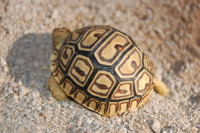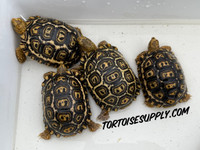
Juvenile Leopard Tortoise (2 year olds)
- Availability:
- Two available as of April 2, 2026
- Shipping:
- Calculated at Checkout
Common Name: Leopard Tortoise
Scientific Name: Stigmochelys Pardalis Babcocki
Current Size: 4" range
Average Adult Size: 10-16" (females larger)
Area of Origin: East Africa
Description: Sandy yellow color with variable black splashes throughout the shell. These tend to be a high domed tortoise, with males normally a bit more elongated and narrow than the rounder, wide females.
Habitat: Hot, dry climates. This is one of the few tortoises that really struggles in high humidity areas (they can handle moderate humidity). They do not brumate/hibernate, but will go through a winter slow down period during cooler weather and shortened daylengths. As adults, they can safely handle body temperatures as low as 50 degrees at night as long as they are able to heat up into the 70's during the day. Summer highs up to 120 degrees can be tolerated as long as there is a cooler, shaded retreat the tortoise can get into. Dampness is not a problem in high temperatures (a cool mud hole on a hot day), but in cooler weather the tortoises should be kept dry. As babies, these tortoises spend almost all their time in washes and underground in rodent burrows, giving them a more humid and stable environment than you'd picture the desert to be. Because of the dry climate and low calorie natural diet, their growth rates in the wild are significantly slower than they are in captivity.
Diet: This tortoise is naturally a grazer, and will wander about nibbling on grass the majority of its natural life. In captivity, larger leopard tortoises will graze on grasses as well as leafy weeds and clover (dandelions are a favorite). As babies, we focus more on feeding them a mix of leafy greens and weeds, since they have a harder time eating the more tough grass.
Adult Behavior: Adult leopard tortoises are interactive and curious tortoises. They are generally non-aggressive in groups. Our adults that have always been housed in groups, have no problems living together in mixed-sex groups. They do not dig burrows or even shallow 'scrapes', but will retreat to the base of a bush or shaded overhang in hot or cold temperatures. Most leopards will eagerly come to their keepers looking for food once they are comfortable in their environments. These are a good choice for Southern, warm climates. They will struggle in cold climates and temperatures, and are one of the tortoises more prone to respiratory issues in cooler conditions. With minimal digging, they are easy to contain with only about a 16" wall height keeping adults in.
Our Current Care: During cooler weather or indoors, these tortoises are kept indoors on a damp coco coir substrate with a hide box or two that they can get into to feel secure and have a more humid hiding area option which is critical for smooth shell growth. We house them in cheap, simple plastic tubs that can be purchased at WalMart or Target, generally 3 to 4 square feet in size for babies, and larger enclosures like stock tanks for juveniles. Low sides work best as excess heat can escape and makes viewing and access much easier. We prefer not to use sand as a substrate as it sticks to the food offerings and gets inadvertently eaten and can accumulate in the gut (in the wild, sand/dirt is generally hard packed and the food is generally dry, and is up off the surface, so it doesn't get eaten much in the wild). Temperatures in the room fluctuates between 70 at night up to 80 during the day in the summer months, with a heat light/heat source overhead bringing a small area (10%) of the enclosure up to about 95 degrees as an option that they can get in and out of as needed. This species, as babies, at night we prefer to keep a small heat source maintaining a temperature around 80 degrees at night. This can be done with a small wattage ceramic heat emitter, heat panel, red bulb or a heat mat placed against the back or side wall of the enclosure to add some warmth at night. During the day, we have a UVB source overhead (generally a linear tube ZooMed Reptisun 10.0 bulb), and larger enclosures will use 80-100W mercury vapor bulbs instead.
The diet we offer almost all our tortoises consists of mixed leafy greens, and our primary list includes dandelion, endive/escarole, turnip greens, collared greens, dark leaf lettuces (green/red), mulberry leaves, grape leaves, plantain, cactus pads, and mallow. We will typically take 4-6 of these items at a time as available and chop it small to prevent the tortoises from being able to avoid any one or two items (sort of forces them to get a little of everything). We top this with a handful of our Herbal Hay. About twice a week we will add calcium or calcium/D3 supplement, twice a week add our Food Fixer supplement, and once a week will add a general reptile/herbivore multivitamin like Repashy Superveggie to the food (these are all powder form). Shake well to distribute, and this is what's fed to all the indoor (generally baby and juvenile) tortoises. Commercial pellets can be dampened to soften them and mixed in as well, and effort should be made to include this occasionally so that they are used to eating it, which helps in a pinch to feed on a day or two where you don't have fresh greens available. Vegetables can be added to the diet for variety, but fruit should generally be avoided as it can disturb their digestive process when they get the influx of sugar.
The tortoises are removed from their enclosure and soaked in a separate 1/4" deep pan of warm water daily or almost daily for 30 minutes each time. We don't generally use water dishes in the enclosures because of the risk of drowning (yes, we have lost babies to drowning when they flipped over in 1/4" of water).
We don't use the "closed chamber" method that has become popular in some groups and forums (keeping them very high humidity and very warm). This speeds up their growth rate but isn't natural in any way, and has significant respiratory risks if temperatures drop (at all), and shell rot and mold are a lot more common. A wild tortoise of any species we keep would never see these conditions more than a few hours at a time in the wild during a summer rainstorm. We keep them with open tops, warmer and cooler areas to go between, with a 'more' humid hide available to use as they want to. They are free to choose the conditions, temperatures, and humidity levels they want within this setup.
2 Reviews Hide Reviews Show Reviews
-
Baby tortises
Got our from the Reptile show in las vegas very smart people and very friendly and helpful would recommend them and time wish they had a local retail store to get supplies easier
-
Male 21/2 yrs old
Bought my new baby at the Sacramento 2010 show, Tyler very nice with lots of information. Tortoise in really good health, seems to be use to people and being handled.
Related Products