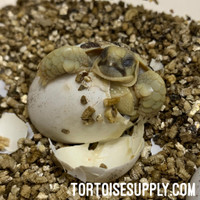
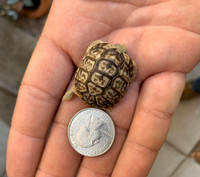
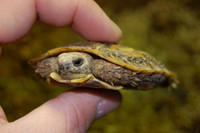
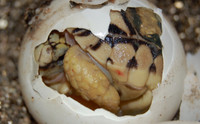
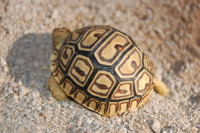
Baby Redfoot Tortoise

- Shipping:
- Calculated at Checkout
- Note::
- We sent our adult redfoots to friends in a better climate for their needs, and occasionally get babies back from them. This is a batch of those babies. They are with us in Las Vegas and ship from here.
Common Name: Redfoot Tortoise
Scientific Name: Chelonoidis Carbonaria
Current Size: 2"+
Average Adult Size: 12-14"
Area of Origin: South and Central America; Few Carribbean Islands
Description: Black shell color, usually with yellow highlights in the centers of each scute of their shell, which are present from hatching (the black color grows in with age). The skin is black, with bright red spots on the front and rear legs. Head color varies between specimens and localities, but is generally black skin with red or yellow scales present mostly on the top of the head. Males generally are a bit more colorful than females. We consider them "watermelon" shaped; somewhat elongated and rounded, no matter which angle you're looking at them from. Males usually have a narrow waistline (hourglass shape) when viewed from above, although this isn't always the case.
Habitat: Naturally these tortoises exist in a wide variety of habitats, from grassland to jungle, almost all with moderate to high humidity and moderate temperatures. They can handle variable amounts of humidity in captivity once grown, but babies should be kept humid to ensure proper smooth growth. They do not hibernate, but will go through a winter slow down period during cooler weather and shortened daylengths. As adults, they can safely handle body temperatures as low as 45 degrees at night as long as they are able to heat up into the 70's during the day. Summer highs up to 100 degrees can be tolerated as long as there is a cooler, shaded retreat the tortoise can get into. Moisture is not a problem in warmer temperatures (a cool mud hole on a hot day), but in cooler weather and on cold nights, the tortoises should be kept dry.
Diet: This tortoise is naturally a browser, and will wander about munching on broadleaf plants and fallen fruit the majority of its natural life. They are known to eat meat in the wild, seen eating dead animals, worms and snails. In captivity, redfoot tortoises will eat almost anything well, such as leafy weeds and clover (dandelions are a favorite), fruit, vegetables and they love Mazuri tortoise diet.
Adult Behavior: Adult redfoot tortoises are interactive and curious tortoises. They are usually unaggressive towards eachother and can usually be kept long term in mixed-sex groups. They are not damaging to their environment, rarely digging holes or burrows. Most redfoots will eagerly come to their keepers looking for food once they are comfortable in their environments.
Our Current Care: During cooler weather or indoors, these tortoises are kept indoors on 2-3" deep moistened coco coir substrate with a humid hidebox that they can get into at night. We raise them in cheap, simple plastic tubs that can be purchased at WalMart or Target, generally 3 to 4 square feet in size for babies. Temperatures in the room fluctuate between 75 at night up to 85 during the day, but we keep the hidebox heated to around 80-85 at night with a heat pad beind it, or a red bulb placed overhead.
Diet consists of spring mix greens with many other leafy greens, fruit and veggies offered in rotation to that (mulberry, bell pepper, apple, pear, melon, mango, papaya, endive, grape leaves, hibiscus leaves, and diced cactus pads). We like to also add moistened Mazuri tortoise diet as well as ZooMed's Gourmet Tortoise Food a few times a week, usually mixed and mashed into the leafy greens. The addition of the commercial diets take care of most or all of the supplementation needs, or you can sprinkle the food lightly with a calcium supplement 2 or 3 times a week and a multivitamin supplement 1-2 times a week. We also throw a pinch of our herbal hay on top of whatever they are eating almost daily, which adds variety and flavor and scent to everything.
The tortoises are removed from their enclosure and soaked in a separate 1/4" deep pan of warm water daily or almost daily for 30 minutes each time. We don't generally use water dishes in the enclosures because of the risk of drowning (yes, we have lost babies to drowning when they flipped over in 1/4" of water).
Being a tropical species, they don't need intense lighting, but they need lights on during the day and off at night to maintain a normal day/night cycle. We use full spectrum UVB lights, which we suggest for the growth of pretty, healthy tortoises, and use a simple spot bulb or ceramic heat emitter for heat in a small part of the enclosure to give them a "hot spot" around 90-95 degrees that they can get into if they want to warm up.
32 Reviews Hide Reviews Show Reviews
-
After 3 years, a happy healthy medium.
Healthy tortoises grow faster than you think they will. My two went from 3 inches to 9 in just under 3 years. They just moved (again), into a 6 foot by 8 foot wood, tile and EPDM pond liner. PLEASE remember that red foots are NOT a small species, and if you house them primarily indoors they WILL outgrow the available tortoise tables and Rubbermaid storage bins before you know it. With that caveat out of the way, red foots are an absolute delight. Mine are as acclimated to the house schedule as my 4 Shih Tzu dogs, and they share the "run of the house" several hours each day. It didn't happen overnight, but my red foots are bold and assertive in this environment. They know the location of every floor vent in the houses heating system, and will NOT hesitate to share (or even evict) the dogs that enjoy them too. We call it "venting". They WILL follow us and beg for more "Salad Du Jour" whenever they are hungry, and they are hungry every waking hour that doesn't involve a scheduled "soak and poop". They don't have any interest in physical affection, but they absolutely have their own agendas and expect us to provide for it on demand. It is easy and inexpensive to feed them well. For every spendy spring-mix or mango they eat, there is another dandelion bunch or prickly pear pad from the yard. Prickly Pear cactus thrives and multiplies like MAD in my garden, and I live in Portland, Oregon! These tortoises have easily met equipment requirements as far as heating and UV light, and they can far more interactive and enjoyable than one might assume. But if you treat them right, they will grow quickly and then quite possibly outlive you. Fantastic experience I wouldn't trade for anything!
-
Healthy Happy Hatchling!
I received my lil one on Tuesday morning. Once I soaked him/her, he/she was ready to eat. Very healthy, very alert, and very curious. Didn't once try to hide back in the shell and once in it's enclosure, was very curious to explore. Very pleased with my baby and highly recommend you to anyone and everyone. Thank you!
-
I love my baby Redfoot!
I've had my baby red foot for just over 2 months and he's doing very well even getting bigger! I would order from you again! The only problem I had and it wasn't you fault, UPS didn't make him him a priority. I live in California only about 4 to 5 hours away from you, and he first went to LA (which is 2 to 3 hours away from me) and it said he was out for delivery there at like 3am then he got to our local UPS and went out for delivery at 8am and didn't arrive here till noon. I thought he would have been their first delivery, but he rode around on the truck for 3 more hours. So he looked a little lethargic at first. I just soaked him and made sure he ate and sat with him on the grass in the sun. He is doing really good now!
-
Loving Life in Alaska
I received my two baby red-foots last February, and they are still loving life. It was incredible to see the way they were shipped over-night from the folks at Tortoise Supply (Bluebeast Reptile at the time), in "heated containers". They took to life in the habitat I had built for them, and they have enjoyed eating all sorts of fresh produce, as well as their feed pellets. Very fun pets.
-
Beautiful healthy tortoise!
I have had my baby redfoot for about a month now and he arrived healthy, alert and hungry. I highly recommend this supplier!
-
Cute!
This website is very helpful! I think I'm gonna get a redfoot.
-
Healthy and Happy
Ever since I purchased my baby redfoot at the Pasadena Reptile Show last fall, she has been delightful. I also love how your site provides essential care information to include how you have been caring for them. I previously purchased from another company, and the tortoise died after a few months. I believe it may have been because my care of may have been different from what it was acostomed to.
-
Outstanding
My Baby Red Footed Tortoise is awsome, he arrived safley. He will not stop eating, and very active, 5 stars
Related Products